Note: This post does not reflect any political affiliations or beliefs. This post includes a dispute that challenges narratives that have been manipulated by the media, which may appear to take the side of what some may deem a controversial set of beliefs, but that is not the case. Please read fully before making assumptions.
One of the most challenging periods of my academic journey was during my final semester of my undergrad. A professor wrongfully cited me for violating the student code of conduct and later retaliated by flunking my assignments when her report was unsuccessful. I spent the entire spring of that year defending my character and keeping records. By the end of the semester, I also spent a lot of time collaborating with my peers to build my report on my professor’s retaliation.
Now, a recent graduate of Applied Linguistics, I want to experience working with forensic linguistics, and I want to start with something meaningful to me. So, this personal project will revisit my academic misadventure with that professor and explore the defense I made for myself that spring of 2019, and the details of the moments leading up to the wrongful accusation. It will explore semantic analysis, indicators of radicalization, and an assessment of the discourse between my teacher and me. This will contain contextual information such as emails, classroom discussion posts, and information from my meeting with Student Affairs addressing my teacher’s retaliation. This will be total amateur work, but it will allow me to practice and to share some form of a forensic linguist project.
Here’s where it started:
Names of participating individuals and institutions are anonymized.
It was January 2019. The Black Hebrew Israelites, the Indigenous Peoples’ March, and the Covington Catholic School’s March for Life all clashed on the steps of the Lincoln Memorial. A viral video spread of what would quickly become known as the “Sandmann smirk”. This incident became a hot topic of interest to my professor because (1) it happened recently at the time of this class and (2) the course was on Native American Literature.
The viral incident of the “Sandmann smirk” was discussed and used as an example of Indigenous oppression during one of our sessions. In fact, it was initially presented by a student who then received positive feedback from the professor.
On that same day, I went home and watched the whole video of that incident. A nearly two-hour-long video, which ultimately denied the credibility and agenda behind the viral clip. It did not fully exonerate the Covington Catholic students; in fact, it showed that all parties contributed to the tension and friction. I saw that the viral clip should no longer be considered an example of the oppression of Indigenous people and shared the whole video on our classroom discussion board, fully stating this (unedited for authenticity):
1/29/19 @21:57 on Discussion Forum, “Current Events/ News/ Social Justice Movements/ Organizations/ Events.”
“Shar Yaqataz Banyamyan’s Video Coverage”
Since it hasn’t been posted yet, this is the full video of the confrontation between the groups of protesters at Lincoln Memorial that occurred earlier this January. To find the viral clip, you will need to view up to about an hour. I wanted to share this because I think it’s important to see how media distorts events and consciously creates stigma and hatred.
If this link does not work, I apologize. The video is still available on YouTube and should be easy to find. Let me know what you guys think. How does media affect you? Does this video provide a different perspective?”
This is how it began.
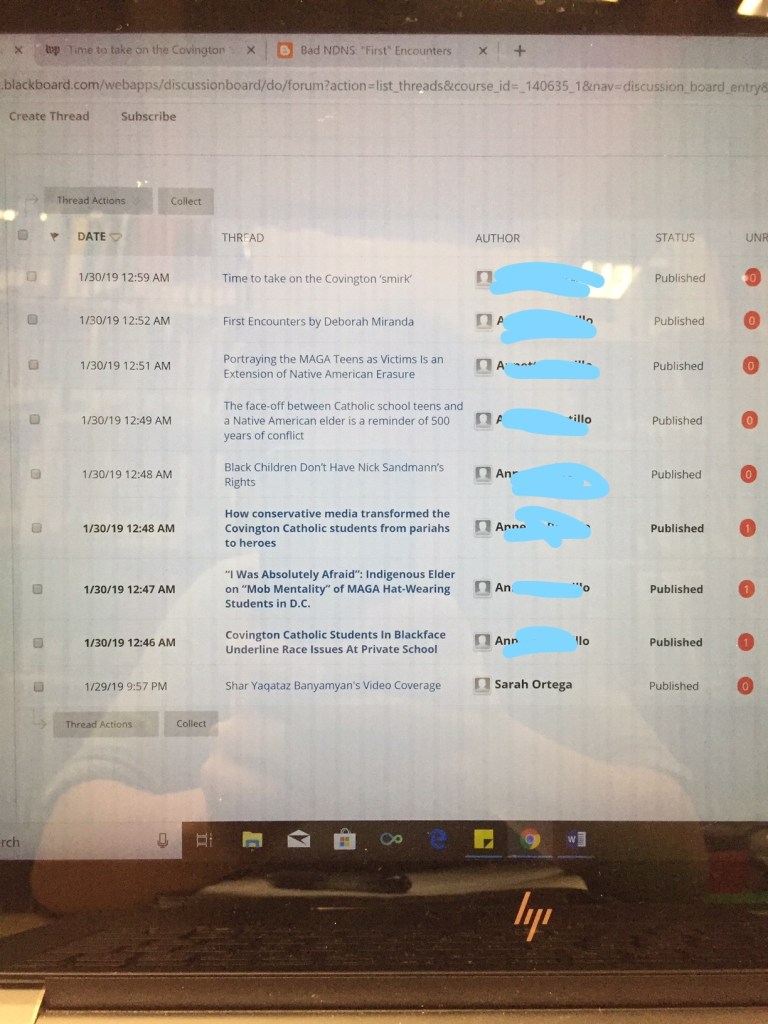
Following my first post, my professor had several responses:
I looked through all the links and responded to her first two responses without directly addressing the new thread. The two links I responded to cover an incident where the high school students make “rape jokes” and also an event where the students are seen in “black face”. Because my professor did not provide any context in her response, I have to assume that she was trying to argue that the Covington Catholic Students have committed enough indecent and inhuman acts outside of the “Sandmann smirk” and his association with the group is enough to villainize him as an individual.
I do not articulate my response very well:
1/30/19 @9:31
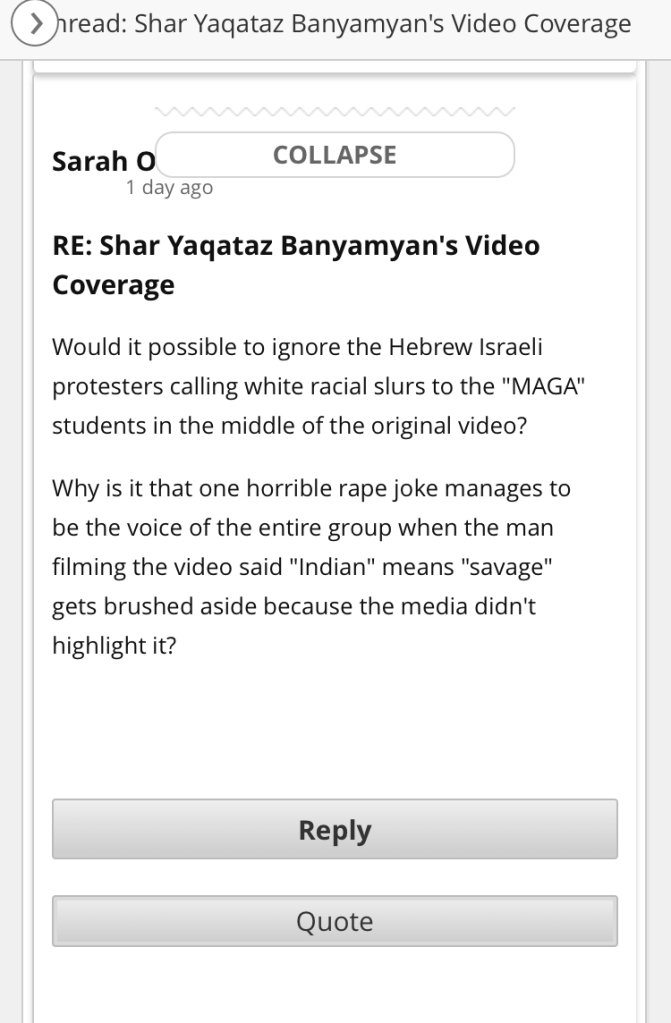
Would it possible to ignore the Hebrew Israeli protesters calling white racial slurs to the “MAGA” students in the middle of the original video? Why is it that one horrible rape joke manages to be the voice of the entire group when the man filming the video said “Indian” means “savage” gets brushed aside because the media didn’t highlight it?
The main point I’m trying to make is that the rape joke (not made by Sandmann) is horrible (and shouldn’t be tolerated), but it’s not grounds to villainize Sandmann as an individual or to use his smirk as a symbol of oppression. If that’s the case, then why aren’t we villainizing the others who contributed to the tension? The man recording the video was part of the Black Hebrew Israelites and said heinous things to both the Indigenous Peoples March AND the Covington Catholic Students, so why is the man recording the video not being targeted the way Sandmann is? Should we blame the media for that?
At this time, I emailed Greg, Head of the English Department, seeking advice on further action. My main concern was that my grades would be subject to unfair judgment due to the nature of my professor’s responses. I wrote the email later that day.
1/30/19 @12:06 PM
Greg,
Good afternoon. This email concerns political bias in a classroom setting. I don’t know who I should contact regarding this. I only wanted to express my concern for my Professor’s response to my discussion thread. I provided a link (unedited and with no underlying agenda) to the thread titled “Current Events/News/Social Justice Movements/Organizations/Events”. Her response was repressive and maybe intimidating. It made me feel that my opinion (non-political) was unappreciated. The discussion board was quickly overwhelmed with biased articles and links, which I took the time to read.
Please see the attachment that organize the links and the event. What should I do further?
1/30/19 @13:49 (From Greg)
Hi Sarah: I’m sorry to hear about your problems in this class, an I certainly hope it doesn’t affect your grades. I think we should meet and we can go through exactly what is happening in the class together. I can meet around 2:30 tomorrow, or anytime next Tuesday afternoon. I’m looking forward to talking to you soon. All best, Greg
1/30/19 @ 15:19 (From me)
Hello, I can meet after that very class which ends at 3:45
1/30/19 @15:50 (From Greg)
Sure; that’s fine. See you tomorrow at 3:45…..
The next morning, I opened blackboard and found two unread messages under my Native American Literature course.
The first reply by my professor, Helen, was posted on the classroom discussion board.
1/31/19 @1:23
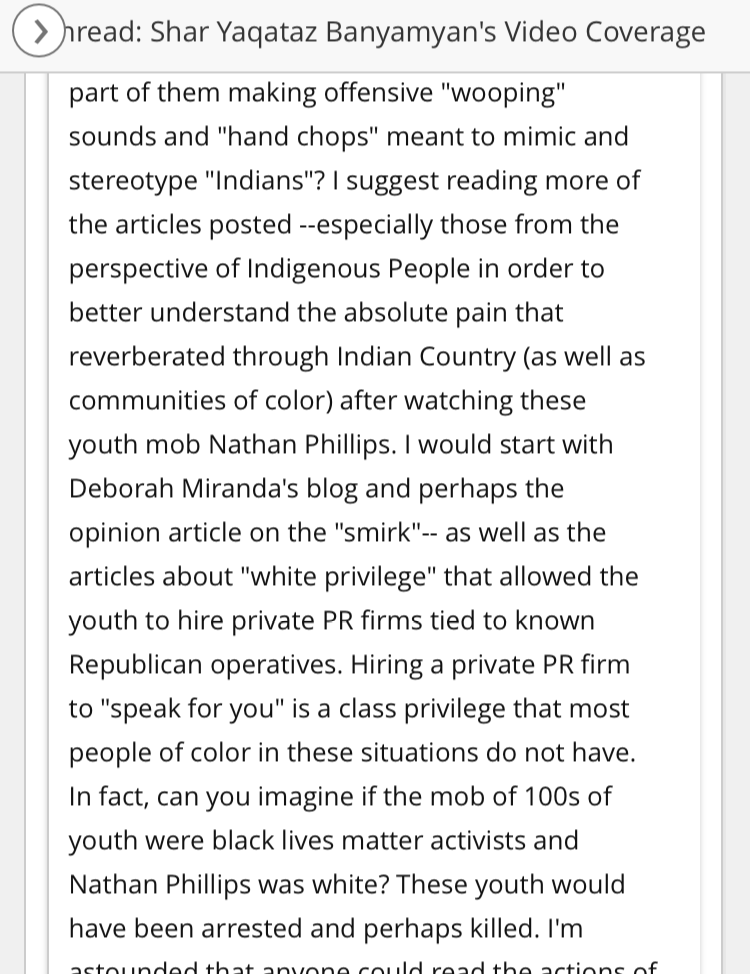
Sarah, Actually, if you read all the articles and blogs I posted, no one is ignoring their comments, but rather contextualize the history of the group and agree that what they are doing in regards to the slurs, etc. is just as offensive as the youth. I certainly don’t agree with them and find their derogatory words towards Indigenous People and others appalling. The members of the Indigenous group willingly placed themselves between these two EXTREMIST groups. The youth have been documented in other videos that have since surfaced acting similarly towards other people in the area –before this entire incident occurred. Did you also gloss over the part of them making offensive “wooping” sounds and “hand chops” meant to mimic and stereotype “Indians”? I suggest reading more of the articles posted –especially those from the perspective of Indigenous People in order to better understand the absolute pain that reverberated through Indian Country (as well as communities of color) after watching these youth mob Nathan Phillips. I would start with Deborah Miranda’s blog and perhaps the opinion article on the “smirk”– as well as the articles about “white privilege” that allowed the youth to hire private PR 6 firms tied to known Republican operatives. Hiring a private PR firm to “speak for you” is a class privilege that most people of color in these situations do not have. In fact, can you imagine if the mob of 100s of youth were black lives matter activists and Nathan Phillips was white? These youth would have been arrested and perhaps killed. I’m astounded that anyone could read the actions of these youth as anything other than mob violence and intimidation meant to instigate Phillips.
Lastly, your comment about rape is unacceptable discourse in this class and will be recorded as a violation of the student code of conduct and [university’s name] core values. One should never make light of or joke about the serious crime of rape and I encourage anyone who has been sexually assaulted to not let your misguided words or the words and actions of these youth to deter them from reporting incidents to the appropriate persons.
The second reply was a private message from Helen sent minutes after this accusation took place.
1/31/19 @1:37
Hi Sarah, can you please set up a time to meet with me to discuss your nonchalant comment about rape. You may need to clarify your comment that I read as violating the code of conduct for students and dismissing the seriousness of sexual assault.
Fig. 1 Images used in Student Grievance Report
Fig. 1 Images used in Student Grievance Report
With the context and detailed background on what instigated this accusation, I will briefly touch on my feelings about the matter. First, I was extremely distraught to be accused of condoning rape in front of my peers. Second, the degree of accusation is not only an insult to my character but also an insult to my past. Helen was ignorant of my experiences with sexual assault and failed to consider the gravity of her accusation toward someone she did not know beyond our student-teacher dynamic. Lastly, her hypocrisy and inability to be professional became apparent, as her public accusation occurred before she considered writing to me to clear the air.
Also, on page 6 of her syllabus, it was clearly stated: “It [the class] will nurture an atmosphere free from…discrimination upon an individual’s political views or beliefs.” I want to clarify that my position was, in fact, neutral and was not directly challenging any political standpoint. However, because I was not supporting the claims the viral clip was illustrating, it may have appeared that I was openly defying its political message. It is possible that Helen’s reaction could have been instigated by her perceiving that I was challenging her political stance rather than the role of the media.
Analysis
My goal is to explore possible indications of radicalization in my professor’s language. Because the samples are very small, my results cannot be conclusive, which is fine in this case since I am simply exploring tools and frameworks specific to counter-radicalization. My methodology was inspired by research in threat assessment and violence risk. I want to be clear that I am not implying my professor is prone to violence, nor do I believe she is. I am using these frameworks and approaches to determine what extremist indicators are found in her language. My findings will be standardized by including quantitative methods, which will integrate NLP use, such as Wmatrix, to detect prominent features of her texts with theoretical frameworks for radical indicators. I will also use collocation patterns in the Corpus of Contemporary American English (COCA) to elaborate my defense.
My defense:
What got me in trouble was the use of “rape joke” in my reply. So, according to Helen, saying “rape” next to “joke” means that I support rape and possibly find it funny (?)
The defense I made with Student Affairs at the time was along the lines of “well, she sent me the article that has ‘rape joke’ in its title, by proxy, does that mean she condones rape too?” More specifically, I clarified that my construction of “rape” and “joke” as a phrase was not a reflection of my opinion but that of the very title of an article my professor sent in one of her replies. Clearly, I remain concerned that it was the sole consideration that got me out of trouble.
Knowing what I know now, let’s consider an alternate reality where she sent the article about the “rape joke” incident, but it wasn’t stated within the title. Would I be in hot water then? It would have been harder to show that the construction of that phrase was not a reflection of my opinion. Using the frequency of collocation patterns in corpus linguistics, I can further solidify my defense.
COCA is an American English database with over a billion words gathered from various sources. Using the collocation search feature, I input “rape” as the target word with +1 for all words that followed “rape”, meaning I searched for all two-word phrases that started with “rape” across the entire corpus. I also sorted by relevance with a minimum score of 20 to eliminate highly frequent words such as the, and, or are.
Jokes occurred 16402 times across the corpus, and 141 of those occurrences were connected to rape. This is a percentage of 1.65%. The phrase rape jokes also has a mutual information (MI) score of 8.08. This is significant because an MI score measures the strength of association between the indicated words, illustrating how often they co-occur. As a rule-of-thumb, an MI score of 3 or higher is considered evidence of a noteworthy association, that the two words are collocates. Then the word joke occurred 36085 times across the corpus, with 43 occurrences linked to rape. A percentage of 0.12%. The phrase rape joke has an MI score of 5.23.
Fig. 2 Images of COCA collocation results
It’s now more apparent that the phrase is not unfamiliar to the media and has made an appearance enough times to be noted as a collocate. If I could go back in time while sitting in that frigid office with Student Affairs, I would have liked to show them that my use of the phrase was not a combination inspired by my own moral framework but rather a byproduct of the media.
Let’s entertain that I constructed the phrase “rape joke” by my own accord. It’s an original phrase that has not achieved notable association in an American English corpus. What Helen and the Department of Student Affairs blatantly ignored is the adjective “horrible” I placed in front of it. Even if the phrase were my own construction, I associated the term with a negative description. If we want to assume my opinion based on my use of the words “horrible rape joke” rather than “rape joke,” then wouldn’t that mean I actually condemn rape?
Helen’s language:
Following J.Ebner et al.’s (2023) initial approach to their analysis, I will also be using the Institute for Strategic Dialogue’s (ISD) definition of extremism: “…the advocacy of political and social changes in line with a system of belief that claims the superiority and dominance of one identity-based ‘in-group’ over an ‘out-group’. It advances a dehumanising ‘othering’ mind-set incompatible with pluralism and universal human rights, and can be pursued through violent and non-violent means.”
In their recent study on assessing the violence risk of far-right extremist groups, J. Ebner et al (2023) associated extremism with identity fusion, which integrates personal agency with shared identity markers among group beliefs and practices. They determine that “fused individuals tend to view members of their in-group as kin-like” and employ kinship language such as “brotherhood”. The authors sought linguistic markers of identity fusion, and their framework also considered combinations with these indicators, such as existential threat perceptions, out-group dehumanization, and violence-condoning norms (Ebner et al, 2023). Their indicators, with the exception of violence-condoning norms, have been used as the baseline for extremist/radical indicators in my professor’s accusation.
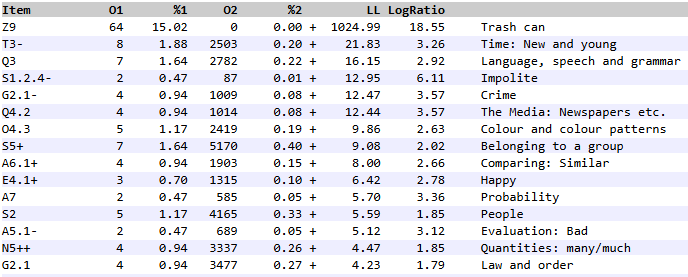
Previous research that has analyzed extremist text has utilized lexicon-based tools such as Linguistic Inquiry and Word Count (LIWC) and corpus-linguistic tools such as Wmatrix, which calculate and match the percentage of words in predefined categories (e.g., semantic domains) (Litvinova & Litvinova, 2020). This analysis will implement Wmatrix for its analysis capabilities, particularly in indicating the significance of a text’s frequency of a word or phrase. I compared my professor’s accusatory text of a mere 358 words to the American Corpus. The primary domains (excluding the Trash Bin, which contains punctuation marks) were Time: New and young, Language, speech and grammar, Impolite, Crime, The Media, Colour and colour patterns, Belonging to a group, Comparing, Happy, Probability, Evaluation: Bad, Quantities, and Law and Order.
These primary domains were the only ones with a log-likelihood (LL) value of 3.84 or higher, which is statistically significant at the p<0.05 level. This means the results occurred with 95% certainty, less than a 5% probability that they occurred by chance.
Fig. 3 Wmatrix semantic frequency compared to COCA
There is a clear binary and exclusionary framing that is indicative of extremism, which will be detailed further. The top domain with a critical LL value of 21.83 (15.13 LL is considered to be at the p<0.0001 level) is Time: New and Young. The concordances of this domain strictly refer to “youth,” which my professor uses to refer to the Covington Catholic Students.
Fig. 4 Concordance lines for Time: New and Young domain
With this context in mind, it would be more appropriate to categorize these results with the domain Belonging to a group, which included other terms such as “members” and “group” in Figure 5. Although there are no indicators of kinship language, there is a notable us vs them narrative. Nathan Phillips is mentioned as a victim individually, but when considering the primary alleged antagonist, Sandmann, the individual is not mentioned. There is a fixation on his ‘group’ as a whole.
Fig. 5 Concordance lines of domain Belonging to a group
References to the ‘youth’ are consistently associated with another group term, ‘mob’, indicating a strong negative perception of the determined out-group. It is also noteworthy that ‘mob’ is used as both a noun and a verb regarding the students; Wmatrix caught this and did not include the verb in the group domain. This association may not be a clear indicator of the dehumanization of an out-group, mainly due to the lack of derogatory terms directed at them. However, there is a strong tendency to villainize the out-group. Out-groups, if we consider her brief mention of the Black Hebrew Israeli group as another extremist group.
Her in-group terms use “members” and “communities” in association with a pacifistic role under threat of the out-group. The sentence, “the Indigenous group willingly placed themselves between these two EXTREMIST groups”, echoes principles of sacrifice and virtue, which further polarize the framing of these groups. Under COCA, to place oneself between two parties, particularly aggressors, is a common cluster that is associated with individuals trying to create peace or to protect.
Fig. 6 Concordances of domain Colour and colour patterns
Returning to indicators of extremism, fixation occurs across various models (Araque et al, 2022). According to Araque et al (2022), fixation is any behavior that demonstrates a person’s increasing preoccupation with a person or cause that has commonly been accompanied by failing relationship or work performance. It seems fair to assume that Helen has displayed the defined fixation, as this has impacted her classroom management and her authority as a grader (see the bottom for her retaliation). The concordances of the domain Colour and colour patterns further display a group polarity. White versus black. White versus color. The white group represents a privileged and villainous class, and the black and colored groups represent the victim class. Her fixation clearly resides within left-wing ideology, but I will not comment on the political or sociological implications, nor will I argue these beliefs; this is purely an assessment of extremist language and its indicators.
One final note on in-group mentality before moving further into existential threats is the possibility of identity fusion. Fusion, as mentioned before, integrates personal agency with group beliefs and practices. An example of this fusion can come from shared trauma or deeply transformative events (Ebner et al, 2023). Helen acts as a representative of in-group suffering, for example: “I suggest reading more of the articles posted– especially those from the perspective of Indigenous People in order to better understand the absolute pain that reverberated through Indian Country (as well as communities of color) after watching these youth mob Nathan Phillips.”
Looking closer into frameworks of extremist language, existential threat perceptions entail beliefs of danger and threat posed by the out-group, whether absolute or not. Helen’s assumptions of violence of the out-group have already been expressed by her use of “mob”, and then she further engages with conspiratorial myth behavior. When Helen said, “…can you imagine if the mob of 100s of youth were black lives matter activists and Nathan Phillips was white? These youth would have been arrested and perhaps killed”, she portrays inevitable injustices and possible violence.
Domains Happy refers to her use of “smirk”, “make”, and “joke”, which mainly encompasses her accusation toward me. Domain Evaluation: Bad refers to her use of “appalling” and “derogatory”, which are her comments on the actions of the out-group. These results are replicable. If readers are more interested in the concordances not shown, save my professor’s response as a txt. file, access Wmatrix, and upload the txt as a corpus. Under the semantics section, select the American Corpus to compare it to.
Overall, Helen’s language in this portrays indicators of radicalization and extremism. It should be noted again that this sample is incredibly small, and more data would be needed before making assumptions. The goal of this project was to assess linguistic features of extremism, and Helen’s language displays group identity, identity fusion, negative out-group perceptions, and existential threat beliefs.
Final notes:
My professor’s retaliation is an entire ordeal outside the scope of this exploratory study. However, I invite anyone to view my (anonymized) grievance report below.
It will take a lot more behavioral evidence to confidently and publicly accuse someone of condoning rape. Sexual assault should not be taken lightly, nor should how we accuse others of supporting it. The term “rape joke” alone, especially in the context I used it, does not come close to reflecting my opinion. My opinion of academic administration and classroom management, however, is strong and has driven my interest in behavioral analysis and counter-radicalization in areas of education, law, and policy.
References
Araque, Ó., Sánchez-Rada, J. F., Carrera, Á., Iglesias, C. Á., Tardío, J., García-Grao, G., Musolino, S., & Antonelli, F. (2022). Making Sense of Language Signals for Monitoring Radicalization. Applied Sciences, 12(17), 8413. https://doi.org/10.3390/app12178413
Davies, Mark. (2008-) Collocates data from The Corpus of Contemporary American English (COCA). Data available online at https://www.collocates.info.
Ebner, J., Kavanagh, C., & Whitehouse, H. (2023). Assessing Violence Risk among Far-Right Extremists: A New Role for Natural Language Processing. Terrorism and political violence, 36(7), 944–961. https://doi.org/10.1080/09546553.2023.2236222
Litvinova, T., Litvinova, O. (2020). Analysis and Detection of a Radical Extremist Discourse Using Stylometric Tools. In: Antipova, T., Rocha, Á. (eds) Digital Science 2019. DSIC 2019. Advances in Intelligent Systems and Computing, vol 1114. Springer, Cham. https://doi.org/10.1007/978-3-030-37737-3_3









 Sarah Ortega