
Corpus and Stylistics: Shirley Jackson’s The Haunting of Hill House
1. Research context and significance
Fowler (1977) introduced “mind style” as the systematic linguistic and textual patterns used to represent a world view and an individual’s mental self. The linguistic phenomena that can contribute to these patterns include choices of syntax, semantics, and transitivity (Leech and Short, 2015). The identification of linguistic consistencies in an analysis of mind style requires two considerations: how the individual conceptualizes their experiences and the individual’s way of perceiving reality. This report will utilize different approaches to investigate whether The Haunting of Hill House by Shirley Jackson has features of mind style occurring across the novel as a whole, and if not, what features contribute to its disturbing atmosphere. This will include a manual approach and corpus methods, which may support my findings.
The Haunting of Hill House was published in 1959 and has captivated the literary community as a psychologically thrilling haunted-house story, and has further enticed modern viewers with its film adaptations: “The Haunting” in both 1963 and 1999, and Netflix’s “The Haunting of Hill House” (2018). In the novel, Eleanor is invited to partake in the paranormal investigation of a haunted mansion known as Hill House. Having taken care of her invalid mother for all of her young adult life, Eleanor is left in a state of desperation to establish her independence and to form connections with others. Her trauma of losing her mother and emotional vulnerability, which will become apparent from her paranoid thinking, seems to make her more susceptible to the supernatural events at Hill House. Her anxiety and paranoia ultimately led her to decide to forever join Hill House by committing suicide.
According to NHS UK, psychosis is a collection of symptoms that cause a person to lose contact with reality, which can encompass hallucinations, depression, and disordered thinking, which aligns with the experiences of most protagonists in Shirley Jackson’s works. The Haunting of Hill House was written and published during a Contemporary/Postmodern literary period where elements of fragmentation, unreliable narration, and political criticism were common, especially in regard to a postwar American society that advocated for the institution of marriage and the nuclear family. And like most 19th-20th century gothic fiction, which The Haunting of Hill House falls under, the setting typically acts as a conduit empowering the characters’ psychological fantasies to manifest (Leech and Short, 2017). This element of gothic fiction is reflected in Eleanor’s perception of Hill House and her relationship with it.
Mind style has been applied to a range of unique fictional minds. To name a few, Semino and Swindlehurst (1996) investigated conceptual metaphors in One Flew Over the Cuckoo’s Nest to illuminate the mechanistic world view of Bromden, a paranoid schizophrenic, Leech and Short (2017) studied syntax via transitivity patterns of Benjy’s mind style in The Sound and the Fury, and McIntyre and Archer (2010) used a corpus-assisted mind style analysis on Miss Shepherd from the play The Lady in the Van, introducing a quantitative supplement to the qualitative nature of mind style studies. With the USAS and Wmatrix semantic tagging tool, they searched for consistent semantic patterns in Miss. Shepherd’s pessimistic and guilt-ridden mind style. Shirley Jackson’s works contain many mentally deviant characters, and none have been subject to a mind style analysis. This report will also use semantic analysis to determine if it supports Eleanor’s odd mind style and the textually unique patterns of her psychosis, which often blur the distinction between a paranormal event and the manifestation of her mental decline.
2. Data and methodology
Features of mind style will be investigated through the lens of a third-person narrator observing how Eleanor’s worldview, including her psychosis, and, by extension, the paranormal, are construed. To start, I compared The Haunting of Hill House corpus to a fictional baseline represented by the Brown sub corpora of fiction following McIntyre and Archer’s (2010) approach to semantic categorization. The keywords were categorized with the Wmatrix semantic tagger to get an overall representation of the novel’s atmosphere and the general attitude of the narrator.
I wanted to consider the key semantic domains of the abnormal events to see how they are construed in comparison to the novel as a whole. This would hopefully suppress the narrator’s language patterns and give Eleanor’s mind style a chance to emerge since these events are more deeply involved in Eleanor’s mind and perception. To semantically analyse the abnormal occurrences, I separated the paranormal events and Eleanor’s episodes, some of which overlap, into a separate file and used The Haunting of Hill House corpus as a comparison to see what themes stand out during these shifts in reality. Separating these events was a subjective process, and how I separated them may be different to how someone else would. The chosen occurrences include (1) the storm when everyone hears the banging of the doors, (2) Eleanor realizing she was not holding Theodora’s hand, (3) the family picnic, (4) Eleanor going to the library, and (5) when Eleanor decides to drive her car into a tree. I excluded the “Help Eleanor Come Home” scenes because these are aftermath events, the reader is not taken through a transformative moment in reality.
This is accompanied by a brief qualitative analysis of mind style. In most literary analyses, Eleanor is characterized as someone who is desperate for independence, distorted[1], fanciful, and in some arguments, sexually repressed. The novel’s overall tone is unsettling and invites the notion that sanity can transform reality, challenging what is paranormal and what is a manifestation of one’s own mental state. More on this can be found in Brittany Roberts’ “Helping Eleanor Come Home: A Reassessment of Shirley Jackson’s The Haunting of Hill House” (2017) and Michael Wilson’s “’Absolute Reality’ and the Role of the Ineffable in Shirley Jackson’s The Haunting of Hill House” (2015). However, these characterisations do not follow Fowler’s (1977) definition of mind style, which requires a consistent defining linguistic feature that represents the world-view of a character or narrator. From my own assessment, the novel’s possible features of mind style include (1) agency and animacy that assign Hill House with autonomy and (2) paradoxical semantics. Both of these may represent a distorted worldview from Eleanor’s whimsical and fantasizing nature. My analysis of the key semantic domains will be used to see if this supports my conclusions.
3. Analysis
Before comparing the keywords and semantic domains that appear throughout the novel and its abnormal events, I’ll first explore possible features of mind style, which may or may not be supported by the quantitative evidence.
3.1. The distorted mind style of Eleanor Vance
From the very beginning of the novel, Hill House is diagnosed as not sane, which is a mental characteristic ascribed to a person and not typical for a house. These kinds of personifications continue throughout the novel, demonstrating Eleanor’s perception of the house as a living entity with its own motives. After terrifying the other characters by nearly killing herself, Eleanor is asked to leave the house, but she believes the house can decide on who stays and who doesn’t:
She could see the windows looking down, and to one side, the tower waited confidently. She might have cried if she could have thought of any way of telling them why; instead, she smiled brokenly up at the house, looking at her own window, at the amused, certain face of the house, watching her quietly. The house was waiting now, she thought, and it was waiting for her; no one else could satisfy it. ‘The house wants me to stay,’ she told the doctor, and he stared at her.
[Shirley Jackson, The Haunting of Hill House: 82]
Eleanor’s odd perception of the house not only assigns living behaviour to the house but its parts, such as its windows and its tower. The example includes windows looking down, the tower waited, the house was waiting, and wants her to stay. She even sees the house having a certain face that is watching her quietly. Eleanor also ascribes mental and physiological aspects to the house by calling it a lunatic and diseased, expanding on its initial impression as not sane. Eleanor will very early on perceive a predator-prey relationship with it:
I am like a small creature swallowed whole by a monster, she thought, and the monster feels my tiny little movements inside.
[Shirley Jackson, The Haunting of Hill House: 17]
Though Eleanor sees Hill House as autonomous, she also perceives its malicious intent, likening it to a monster that swallows and consumes its prey. Contrary to Eleanor’s view, the other characters do not ascribe living aspects to the house. For example, Theodora calls it filthy and rotten, which is more appropriate than diseased when describing a house. This literary choice contributes to Eleanor’s possible deviant mind style, giving life to what is not living. Paradoxical semantics also appear for various actions and nouns throughout the novel and occur often when Eleanor is in her head. In this scene, which was included in the abnormal events file, Eleanor is daydreaming as Luke and Theo are walking far behind her:
Luke was wrong about the softness everywhere, because the trees are hard like wooden trees. They are still talking about me, talking about how I came to Hill House and found Theodora, and now I will not let her go. Behind her, she could hear the murmur of their voices, edged sometimes with malice, sometimes rising in mockery, sometimes touched with a laughter almost of kinship, and she walked on dreamily, hearing them come behind. She could tell when they entered the tall grass a minute after she did, because the grass moved hissingly beneath their feet and a startled grasshopper leaped wildly away.
[Shirley Jackson, The Haunting of Hill House: 72]
An interesting phrase Eleanor makes regards the trees being hard like wooden trees, when in fact trees are made of wood. This unnecessary simile suggests that there are trees in Eleanor’s reality that are not made of wood, that by some whimsical chance they could be made of something unnatural. Then there is the grass moved hissingly, which can make a reader pause. To move hissingly is often attributed to a snake’s movements, otherwise hissingly is usually ascribed to sounds rather than the movement of objects. The particular word choice gives the grass snakelike attributes, transforming the blades into slithering creatures. If Eleanor were perhaps of more sound mind, she might have thought “the grass moved like snakes” or “the grass made a hissing sound”. This may be a weaker argument supporting Eleanor’s paradoxical style, but it does otherwise follow her pattern of distorting reality. Other examples of paradoxical modifiers and irrational metaphors throughout the novel include phrases such as danced gravely, slept watchfully, growing blackly, and wild sadness, which invite the reader to try to interpret what these would mean. This challenge of logic is an aspect of semantic deviation (Short, 1996).
3.2 Key concepts of the novel and the abnormal
Unsurprisingly, the semantic domains of the keywords shown in Table 1 contain speech and communication, character names, and parts of buildings, which refer to the house this story takes place. The uncategorized keyword list[2] also features Eleanor (619 occurrences) as the most common word, which is also expected since this is told in her point of view. Though Eleanor’s nickname, Nell (55 occurrences; p<.01) and Nellie (10 occurrences; not significant) are not as frequent in comparison, the narrator and the voices from the abnormal events do not conform to the nicknaming the other characters do and continue to address her as Eleanor. [3]
| Table 1. Key semantic domains of The Haunting of Hill House (reference Brown fiction corpus) | ||
| LL (critical value = 15.13) | Semantic domains | Examples |
| 90.55 | Speech: Communicative | Said, told, voice, say, saying, talking, speak, spoke, talk, voices, whispered, story |
| 49.94 | Personal names | Eleanor, Luke, Mrs., Arthus, Dr., Nell, Eleanor’s, John, Hugh, Montague, Arthur’s, Luke’s (Theodora, Theo) |
| 39.83 | Medicines and medical treatment | Doctor, doctor’s |
| 39.70 | Parts of buildings | Door, room, hall, verandah, windows, floor, doors, wall, rooms, doorway, window, front, gate, parlour, stairway, upstairs, walls, staircase, hallway, roof, passage |
| 39.04 | Linear order | Then, first, before, at, finally, last, turn |
| 38.84 | Thought, belief | Thought, think, feel, thinking, believe, wonder, wondering, felt |
| 22.07 | Fear/shock | Afraid, frightened, fear, shock, frighten, scared, startled, terror, shocked |
| 22.00 | Pronouns | I, she, her, you, it, he, they, that, me, we, my, them |
| 20.26 | Architecture, houses and buildings | House, tower, houses, built, apartment |
| 17.90 | Moving, coming, and going | Go, come, going, went, came, coming, left, leave, get, ran, turned, followed, nodded, gone, sat, step, walking, journeys, steps, walked, rose, run |
| 16.01 | Location and direction | Here, this, where, away, there, back, around, out, stood, end |
| 15.53 | Darkness | Dark, darkness, darkly |
There are a few considerations to address before analysing the semantic domains. Medicines and medical treatment contain doctor and dr. which exclusively refer to Doctor Montague, so the correct domain for these examples would have been personal names. Wmatrix also did not recognize Theodora and Theo as character names, which I have added to the examples. The Trash can domain was removed because it only contained punctuation.
Thought/belief have a unique dominance in the novel, illustrating that Eleanor is in her head unusually often whether it be during her stream of conscious daydreaming, when she’s formulating judgements of others or herself, or when she’s experiencing something that could be paranormal. But this does not speak much on her mind style as it is not a pattern reflecting her perception of the world. It is also unsurprising that Fear/shock and Darkness are also significant semantic domains. These categories likely are the cause for giving The Haunting of Hill House such an unsettling atmosphere. Again, this does not directly contribute to the mind style conclusions I made in the previous section.
The Parts of buildings domain may better support Eleanor’s mind style since my previous examples include the human-like descriptions given to not only the house but parts of the house as well. The concordance lines in Figure 1 show a colourless representation of the setting and doesn’t contain any of the personifications mentioned in my manual assessment. Any descriptions in this sample relate to loud sounds, and objects, like floor and rooms, are often used as part of referential statements.
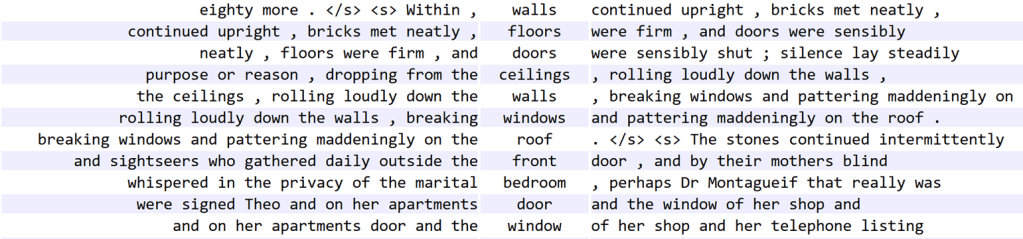
Figure 1. Concordance for parts of buildings from Wmatrix
Eleanor’s mind style may still be consistent throughout the novel even though it is not supported in the semantic analysis of the novel as a whole. Focusing now on her daydreams, psychosis, and paranormal occurrences, Table 2 show the key semantic domains that may better support my conclusions.
| Table 2. Key concepts of the abnormal events (reference The Haunting of Hill House) | ||
| LL (critical value = 15.13) | Semantic domains | Examples |
| 52.46 | Plants | Grass, trees, flowers, garden, daisy, bushes |
| 40.53 | Sensory: Sound | Heard, footsteps, listening, hear, hearing, sound |
| 39.98 | Moving, coming and going | Go, come, ran, came, going, walking |
| 35.29 | Colour and colour patterns | White, black, green, whiteness, blackness, |
| 24.92 | Anatomy and physiology | Feet, hand, breath, wake, eyes, hands, shivering, sleep, arm, fingers, mouth, bones |
| 20.68 | Grammatical bin | The, and, to, of, a, in, on, at |
Previously I mentioned that Eleanor is in her head a lot throughout the novel. She thinks possibly more often than she speaks. During these abnormal events, Eleanor is not more uniquely in her head than she normally is, this could be due to maybe some counterbalancing of the increased frequency of the sensory domain. The first key domain introduces Plants which scores 52.46 (p<.0001). Plants don’t even make it on the top 220 key domains for the novel as a whole. The second key domain shows Sensory: Sound which scores 40.53 (p<.0001) and also achieves significance to the novel as a whole scoring 9.10 (p<.01). There is also a sudden splash of Colour and colour patterns with a score of 35.29 (p<.0001). When compared to the novel as a whole, Colour and colour patterns never reach significance with only a log-likelihood of 0.22.
The abnormal events in the novelcontain the most fanciful and fairyland daydream qualities of Eleanor’s worldview, this is supported by the presence of her paradoxical semantics[4]. These events, which are questionably paranormal, are more vividly portrayed than the moments leading up to them, as pointed out in the Parts of buildings concordance lines. The concordance of the Plants domain shown in Figure 2 demonstrates the visual nature of these abnormal events. Many of the items listed in this sample are connected to visual and textural modifiers, actions, and prepositions.
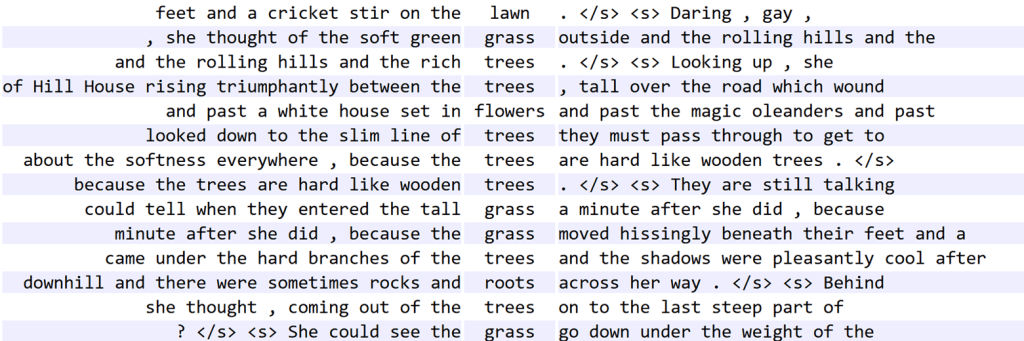
Figure 2. Concordance lines for plants from Wmatrix
However, this cannot completely support my mind style analysis. Parts of building and Architecture are not significantly frequent domains in this comparison, so this assessment also would not support my conclusions on the personifications of the house and parts of it.
4. Conclusion
My report and McIntyre and Archer’s (2010) analysis of Miss Shepherd open up the question as to whether corpus methods can be used to identify and support mind style. As shown, it can at least lend some support. Manual approaches are still more reliable for finding linguistic deviations than automation, and dealing with a third-person narrative can also pose challenges. When looking for features of mind style, I had to consider whether I was looking at Eleanor’s mind style or the narrator’s. Focusing on Eleanor’s mind style meant finding indicators such as what Eleanor thought, heard, or saw. Using pronouns like I and she was not an efficient way to find Eleanor’s perception because I could refer to any character speaking, and she could refer to what Theodora, Eleanor’s sister, or Mrs. Dudley sees or hears.
The comparison of key semantic domains in the novel and the abnormal events provided some quantitative support for my assumptions of Eleanor’s mind style and also pointed out other linguistic features that contribute to the novel’s atmosphere. The key to finding this support is similar to McIntyre and Archer’s (2010) semantic analysis, where they had to separate Miss Shepherd’s speech from the other characters to pinpoint distinctions. If I could do a follow-up, I would consider part-of-speech tagging to see if it could be more supportive for mind style in identifying metaphors.
Bibliography
Fowler, R. (1977). Linguistics and the novel. Methuen.
Leech, G. N., & Short, M. (2015). Style in fiction: A linguistic introduction to English fictional prose (Second ed.). Routledge. https://doi.org/10.4324/9781315835525
McIntyre, D., & Archer, D. (2010). A corpus-based approach to mind style. Journal of Literary Semantics, 39(2), 167-182. https://doi.org/10.1515/jlse.2010.009
National Health Service. (2023, September 5). Psychosis. Nhs.uk; NHS. https://www.nhs.uk/mental-health/conditions/psychosis/overview/
Roberts, B. (2017). Helping Eleanor come home: A reassessment of Shirley Jackson’s the haunting of hill house. The Irish Journal of Gothic and Horror Studies, (16), 67-233.
Semino, E., & Swindlehurst, K. (1996). Metaphor and Mind Style in Ken Kesey’s “One Flew Over the Cuckoo’s Nest”. Style (University Park, PA), 30(1), 143-166.
Short, M. H. (1996). Exploring the language of poems, plays and prose. Longman. https://doi.org/10.4324/9781315842080
Wilson, M. T. (2015). “Absolute Reality” and the Role of the Ineffable in Shirley Jackson’s The Haunting of Hill House. Journal of Popular Culture, 48(1), 114-123. https://doi.org/10.1111/jpcu.12237
[1] In Jackson’s notes on the novel, Eleanor is described as “ALL DISTORTED LIKE HOUSE” (Roberts, 2017)
[2] A key word list was originally generated when I was considering using keywords to drive my analysis with collocation patterns and clusters.
[3] This is a reason, among others, why I believe Eleanor is the one who wrote “Help Eleanor Come Home”. I will die on this hill (house).
[4] Two of the paradoxical semantics discussed in the mind style section appear in these concordance lines.


Leave a Reply